WESLEY SAYS...
Rankings are not the result.
Revenue is.
This article explains how we measure SEO success properly. Not by position changes, not by traffic spikes, but by commercial impact.
We look at organic revenue, conversion rate, cost per acquisition and customer lifetime value. We measure visibility properly through impression growth and topical coverage. We track how search influences pipeline, not just last click enquiries.
If it does not connect to profit, it does not go in the report.
SEO should be accountable. It should prove return. It should compound over time and create long term assets for the business.
That is how we measure success.
Let’s be honest.
Rankings look good in a report.
But rankings don’t pay your wages.
If you’re serious about search performance, you need to measure what actually drives revenue. Not vanity metrics. Not screenshots of position changes. Real indicators that show whether your investment is working.
This is how we measure SEO success properly.
And it might not be what you’ve been shown before.
Traffic means nothing without intent.
Instead of asking “Did visits go up?”, the better question is:
Did organic traffic generate enquiries, sales or booked calls?
In GA4 we track:
If your organic traffic increases by 30 percent but enquiries stay flat, something is wrong. That tells us either intent is poor or the website is not converting.
Traffic is a signal. Revenue is the result.
This is one of the most overlooked metrics in SEO.
If 1,000 people visit from Google and only 5 convert, that is a 0.5 percent conversion rate. That is not a ranking issue. That is a messaging or trust issue.
Improving conversion rate from 0.5 percent to 2 percent can quadruple revenue without increasing traffic.
That is real optimisation.
We measure:
SEO should feed conversion optimisation, not operate in isolation.
This is where SEO becomes serious.
Most agencies will calculate cost per lead. Some will calculate cost per acquisition. Almost none go further.
But the real metric is customer lifetime value.
Let’s break it down properly.
If you invest £1,000 per month in SEO and generate 20 enquiries, your cost per lead is £50.
If 25 percent convert into clients, you acquire 5 customers. That makes your acquisition cost £200 per client.
Now here’s the important part.
If each client is worth £2,000 once, that is decent.
But if the average client stays for three years and spends £2,000 per year, that is £6,000 lifetime value.
Your £200 acquisition cost just produced a £6,000 asset.
That is a very different conversation.
This is why SEO compounds. Not just because traffic grows, but because recurring revenue builds on top of earlier wins.
We measure:
When you understand lifetime value, you stop viewing SEO as a monthly expense and start seeing it as a long term asset builder.
That is the calculation most agencies avoid.
We do not.
Rankings alone are too narrow.
Instead, we track overall search visibility:
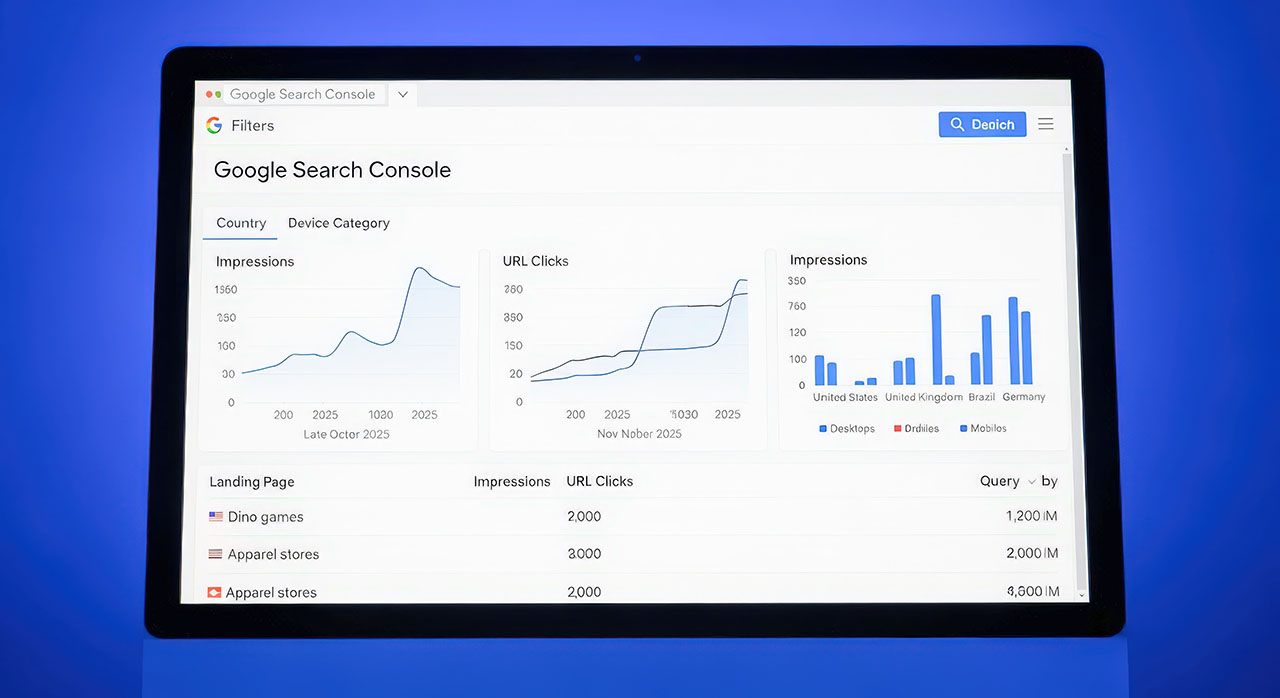
Google Search Console shows whether you are appearing more frequently for relevant queries. That tells us whether authority is growing.
More visibility equals more opportunity.
Modern SEO is not about one keyword per page.
It is about depth.
We measure how well your site covers a subject compared to competitors. Are you answering real questions? Are you supporting commercial pages with educational content?
This is where AI driven search is heading. Google and AI tools reward sites that demonstrate expertise across a topic, not just isolated landing pages.
If users land on your page and leave immediately, rankings will not last.
We analyse:
This tells us whether content matches intent.
Search engines are getting better at understanding satisfaction signals. So should you.
For B2B businesses especially, SEO often influences deals that close months later.
We look at:
Sometimes SEO did not generate the final click, but it introduced the brand.
That matters.
Rankings are a leading indicator.
Revenue is the lagging indicator.
If your agency is reporting on position changes without tying them back to commercial impact, you are not seeing the full picture.
Real SEO measurement answers one question:
Is this generating profitable growth?
If the answer is unclear, the reporting is wrong.
You should know:
If you do not have those numbers, you are flying blind.
And that is not a strategy.
We created a simple scorecard that evaluates:
Clear reporting tied to commercial outcomes.
Request Your Free SEO Analysis today and see where you really stand.
If SEO is working, we will show you.
If it is not, we will show you why.
At Wise SEO, we’re not just about climbing search rankings; we’re about elevating your business.